.png)
How do I break down the plot of my script?
- Hrafnkell Stefánsson
- Oct 20, 2025
- 4 min read

And finding inspirations for scenes

Newsletter #6 - September 22nd 2025
So here’s monday’s newsletter, coming in a little later in the day than usual.
Two weeks ago I had the honor of being artistic director for the Reykjavik International Film Festival Talent Lab - where I meets some fantastic emerging filmmakers, went straight into finishing working a room finishing series outline while preparing (and flying out) for an interview for a posting at a very exciting film school.
So come Sunday - when I had finished all of these things - I totally crashed.
And that was the long winded apology for this coming in late.
We have only one question this week - but it’s a great one.
And as always… don’t overthink it, if you got a question - even it’s just a simple format one, hit the button below and send your question.
And if that link doesn’t work: Questions@theinsecurescreenwriter.com
As always I post last weeks newsletter here on my blog, if you want the answers to your questions sooner... why not subscribe.
QUESTION 1
Norrin from Zenn-La
Hey, I loved your last newsletter, it really felt like a message meant for me. I’ve been feeling down about my writing lately and struggling to create.
My question is about the process of writing a script. I either write random scenes or come up with a good plot idea, but I can never translate a plot into scenes. Do you have any advice on breaking a plot down — and how to find authentic inspiration for the scenes?
Hey,
First, thank you for your lovely message. As with any creative endeavour, insecurity will creep in - and this newsletter is no exception. Every week I worry that I won’t get any questions, so thank you for validating what I do.
I’m really glad you found value in the last issue.
Now, to your question.
It sounds like you’re coming up with ideas and jumping straight into writing scenes. (If that’s not the case, feel free to send an updated question.)
I’ve found that going straight from idea to full script can be very difficult, because while writing scenes you’re trying to answer too many questions at once.
It’s like multitasking while writing - and that rarely ends well for me.
That’s why, for me, preparation before writing any scenes has become the most valuable part of the process.
It’s daunting to sit down and think, I have to write a 60-page pilot or a 90-page feature.
The task is so huge it can freeze you in place.
So instead, I break the work into smaller, manageable steps - each task feeding into the next, each designed to help me develop the idea while only focusing on one aspect at a time.
Of course, this varies a bit from project to project, but here’s my general process:
LOGLINE
Here I just get the general idea down - a short description, maybe 50–100 words.
This isn’t a marketing logline or something for submission; so I’m not worrying if it’s perfect - it’s just for me, a quick reminder of what the story is about.
Here’s an example from a unused project of mine:

1-PAGE SYNOPSIS
A one-page synopsis (with generous white space please) can do wonders.
It’s not a huge leap from the logline - you’re simply expanding the idea a little.
Keeping it to one page forces you to focus on the key beats of the story. Make sure it includes your story from beginning to end.
You can always return to it to remind yourself: What’s my main focus of project?

BULLET-POINT OUTLINE
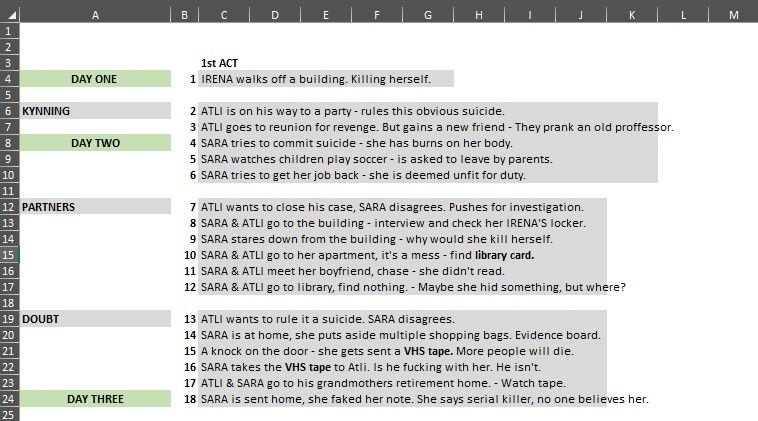
From that one-page synopsis, I move to a bullet-point outline - one single line per scene.
This is a great way to start seeing the shape of the story.
I use Excel for this (you can use anything you like), but I prefer it because:
Excel just keeps going and never starts a new line- which forces me to keep each scene to one line, focusing only on the point of the scene.
I can grab lines and move them around easily - perfect for rearranging scenes.
DETAILED OUTLINE
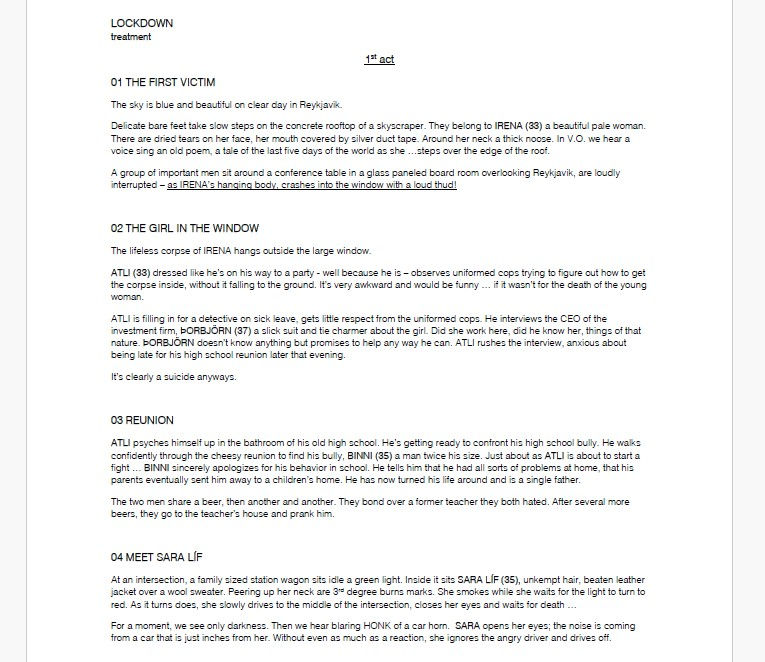
After the bullet points, I can now see the spine of my idea in about 1–2 pages.
Then I take that into a Word document and expand each point into one or two paragraphs, detailing each scene.
By this point, I already know what happens next - so I can focus on how to execute each scene and discover new details within it.
Occasionally I’ll write it almost to the detail, it’s bordering on being a treatment.
SCRIPT
Once the detailed outline is done, I have a 10–20-page document that’s essentially a how-to manual for the script.
This gives me confidence to write the scenes, and it keeps my focus purely on writing great ones. It’s incredibly freeing not having to worry about what happens next - only how best to bring each moment to life.
If you follow a similar process of preparation, inspiration for your scenes will almost take care of itself.
By then, you’ll know the whole clockwork of the film - how every piece connects and moves and can focus on other things.
But if you still get stuck, it’s always worth asking yourself:
What’s the point of the scene? Where is it heading?
What do the characters want - and do they all want the same thing? (They shouldn’t.)
What makes this scene interesting or necessary?
I hope that helps - and good luck with your writing.
If I’ve misunderstood the question or you’d like more detail, don’t hesitate to send another one.
Don’t procrastinate!
Click below and ask me one screenwriting question now, it only takes a minute.
Got a question you want answered about screenwriting? Remember — there are no stupid questions, and I’d love to answer yours.
Remember there are no stupid questions - it could be about story structure, dialogue, breaking in, or even overcoming writer’s block. Whatever’s on your mind, send it along
And if that link doesn’t work: Questions@theinsecurescreenwriter.com
Happy writing.


Comments