.png)
Stop Rewriting. Send the Thing.

Updated: Jun 18
Here's something true about me. Every time I send a piece of work out into the world, I become completely convinced it's terrible. Not “could be sharper.” Terrible. And that conviction is strong enough that I'll put off sending it for weeks.
The only thing that reliably overrides it is a deadline with someone's money attached. Funny how quickly the fear shrinks when there's an invoice involved.
Underneath it is the same thing it's always been: the fear that I'm not actually good enough. I assumed that one would fade with experience. A few credits, a bit of a track record, and surely it packs a bag and leaves.
It hasn't. Still here. Says hi.
So this week's first question landed close to home, because it's that exact loop. And the second is the flip side: once you do decide to put the messy modern world on the page, how do you do it without the page falling apart?
Two questions. Let's get into them.
QUESTION 1
Keith from Australia:
How do I write phone calls, texts, or videos on screen? It looks confusing or like a lot of text when I try?
This is a great question, and honestly it's something I've had to grapple with myself recently.
Because phones are now just part of normal life. Text messages, videos, voice notes, Instagram feeds, TikToks, screenshots, comments, FaceTime calls, all of it. It is just how people communicate now. So of course it is going to end up in scripts as well.
But it can be difficult.
Because the second you start putting all that stuff on the page, the script can very quickly become slow to read. Suddenly you are not writing a scene anymore. You are describing an app.
And that is usually not what we want.
With formatting, my general advice is always the same: find scripts that do something similar and steal what you like.
Look for a produced script that has text messages. Or a video call. Or a news clip. Or social media on screen. Look at how they handled it. If it reads well, learn from it. Most formatting is not about finding the one correct answer. It is about making the page clear for the reader.
But with social media, that can sometimes be harder, because it changes so quickly. A script from ten years ago is probably not going to help you format TikTok comments very well… and trying to understand TikTok makes me feel my age.
Not ancient, but old enough to be super excited by seeing He-Man on the big screen.
So for me, the main thing is to keep it visual and keep it simple.
If it is a video, I usually like to give it a very simple heading. Something like:
VIDEO or INSTAGRAM FEED or TIKTOK:
You get the point. Something clean and obvious.
I don't think we always need INT. or EXT. for that, because we are not really in a normal physical location. We are looking at something on a screen. And we probably don't need DAY or NIGHT. If the video itself takes place at night, then yes, include that in the description. But don't over-format it.
Then describe what we actually see.
Not the whole interface. Not every button. Not the profile picture, the little heart icon, the share arrow, the username, the battery percentage, and the Wi-Fi signal. Unless one of those things matters to the story, leave it alone.
Just pick a style and stay consistent, so the reader learns how to read it.
Where I think writers get into trouble is when they try to include too much. If there are fifty comments under a video, you probably don't need to write fifty comments. You just need to give us the feeling of what is happening.
Then, if one comment is important, pull it out and give it its own line.
That way, the reader gets both things. They get the chaos of the feed, but they also see the important story detail.
Here's a quick example

That is probably enough.
We know it is a video. We know what we are seeing. We know why it matters.
With text messages, I would do the same thing. Keep it clear. If one message matters, give it space.
PHONE or TEXT MESSAGE:
“You should have stayed quiet.”
That reads easily. The reader gets it immediately.
Some writers prefer to handle a single important message like a line of dialogue instead, with a quick cue.
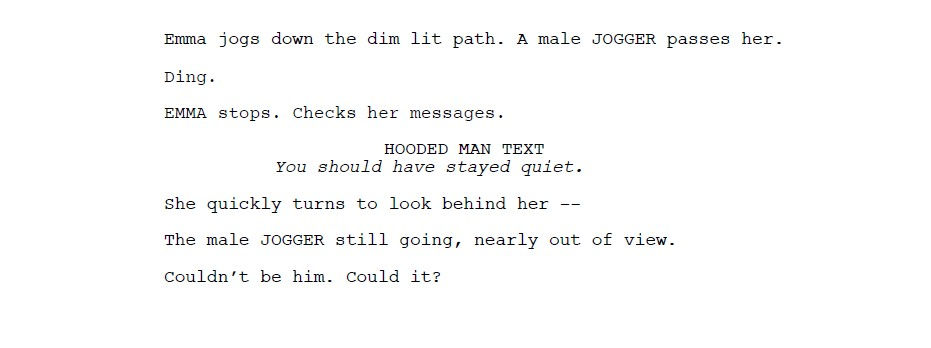
Because that is really the question you should ask yourself: what does the audience need to understand?
If the story needs us to know a video is going viral, show the comments flooding in. If the story needs us to see one threatening message, isolate that message. If the story needs us to understand someone is doom-scrolling through their own public humiliation, describe that feeling visually.
But don't let the formatting become the scene.
There is not one correct way to do this. Anyone who tells you there is one official sacred format for Instagram comments (or anything else for that matter) is probably full of shit, or has spent too much time on reddit or twitter. (I know it's called X but does anyone really call it that?)
So as with everything script. It's always:
Is it clear?
Is it easy to read?
Does the reader understand what they are looking at?
If yes, you're fine.
QUESTION 2
Clara from Luxemburg:
I finished film school recently, and I have a script I started there that I'm still really excited about. I want to send it to producers and apply for funding, but whenever I'm about to do it, I find something else I could improve. How do you know when a script is ready enough to send out?
This is a very familiar place to be.
And I think most writers know this feeling. You finish something. Or you almost finish something. You get close to sending it out, and then suddenly your brain becomes very helpful.
Too helpful.
It finds a scene that could be better. A line that could be sharper. A character who could maybe have a stronger entrance. A midpoint that maybe should move three pages earlier. A typo on page 47. A slightly weak button on a scene. A title you are no longer sure about. And suddenly you are not sending it out anymore. You are doing another pass.
And then another one.
And then another one.
And the problem is, there is always something you can make better.
The script can always be improved. You can always find a sentence to sharpen. You can always make a scene cleaner. You can always discover something that bothers you, especially if you keep staring at the same pages for weeks and months.
So the question is not really, “Is the script perfect?”
Because no.
It isn't.
The question is: is the script ready enough to represent you?
Before we get into the fear part of this, because I do think fear is probably part of this, let's be practical first. The script does need to be ready. You don't want to send out a lazy draft. You don't want to send out something full of typos, half-fixed scenes, formatting chaos, and a third act that has tripped and fallen on its ass.
So first, make sure it has had a real read from people who are willing to hurt your feelings.
And since you have just finished film school, you probably have something very valuable: other writers and filmmakers around you. Use them.
Send it to a few people from film school. People you trust. People who understand scripts. People who can be kind, but honest. Because your mum might love it, and that is nice, but your mum may not be the best person to tell you if the second act is boring.
Ask simple questions.
Where were you bored?
Where were you confused?
Did you understand what the main character wanted?
Did the ending feel earned?
What stayed with you?
What did you stop caring about?
If one person gives you a strange note, maybe it is just one person's taste. That happens. But if three people point to the same problem, listen. That is probably not random. That is the script waving a little red flag at you.
There is also a flip side worth watching for, and it is good news. When the notes start moving away from big structural problems and toward small, subjective things, and when your readers start contradicting each other about preference rather than agreeing on a fault, that usually means something. Contradictory notes often mean you have moved past fixable problems and into personal taste. At that point you are probably closer to ready than the nervous part of your brain is telling you.
Then do one serious pass. One proper pass based on the useful notes.
Then send it.
Because at some point, rewriting becomes hiding.
And I say that with sympathy, because I understand it completely. Every time I send something out, my brain starts preparing for disaster.
They will hate it.
They will think I'm terrible.
They will wonder how I have tricked anyone into ever paying me for this.
None of this is rational. But writers are not always rational people. We are people who sit alone inventing imaginary people and then get our feelings hurt when someone says the imaginary people should talk less.
It's terrifying to send something out.
Because once the script is on your computer, it still has perfect potential. It could be brilliant. It could be the thing that changes everything. It could be the script that proves you are the writer you hope you are.
But when you send it out, the world may say no.
In fact, the world will say no a lot.
You will get no from producers. No from funds. No from competitions. And you will also get the silent no, which is the most annoying no of all.
But a lot of no is still better than sitting on the script forever.
Because no can at least lead somewhere. Sometimes a no means not this project. Sometimes it means not right now. Sometimes it means not for us, but we like your voice. Sometimes it means this isn't ready, but send us the next one. Sometimes it means come in for a coffee.
Come in for coffee was my first big break.
And sometimes that is how it works. You send something out. It does not become the thing you hoped it would become, but someone remembers you. Or they remember the voice. Or they remember that you were serious. And then, three years later, something else comes up, and suddenly that old no was not as useless as it felt at the time.
But none of that can happen if the script never leaves your computer.
So how do you know when it is ready enough?
For me, it is ready enough when the story is clear, the main emotional journey works, the remaining problems are no longer fatal, you can say what it is about in a sentence or two without panicking, and a few trusted readers have responded to it in a way that suggests the script is doing what you intended.
Ready enough to send does not mean there is nothing left to improve. It means this is your best serious version right now. It means you have done the work. It means you are not sending it out just to get rid of it, and you are not holding it back just because you are afraid of being judged.
And once it reaches that point, send it.
Apply for the funding.
Send it to the producer.
Ask someone to read it.
Be ready for no.
Be ready for silence.
Then keep going anyway.
Because that is the job too. Not just writing the script. Putting yourself in the path of opportunity. Letting people react. Letting them say no. Letting them maybe say yes. Letting them maybe say, not this, but what else do you have?
And when an opportunity does come, because if you keep going long enough, it probably will…
Then become the hardest-working person in the room.
And please, be easy to work with.
Talent may get you noticed. But being good, prepared, generous, and not a nightmare to collaborate with is how you get invited back.
So yes, improve the script.
But don't polish it into oblivion.
At some point, send the thing out.
So that's it for this week. If you've got a question — why not send one now? Remember there are no stupid questions: it could be about story structure, dialogue, breaking in, or even overcoming writer's block. Whatever's on your mind, send it to Questions@theinsecurescreenwriter.com.


Comments